Prepared in cooperation with the U.S. Air Force, the U.S. Department of the Interior, the U.S. Fish and Wildlife Service, and the U.S. Geological Survey
National Aeronautics and Space Administration
U.S. Navy (USN)
U.S. Department of the Interior
U.S. Fish and Wildlife Service
U.S. Geological Survey
“An Act to provide for research into the problems of flight within and outside the Earthʼs atmosphere, and for other purposes.”
With this simple preamble, the Congress and the President of the United States created the National Aeronautics and Space Administration (NASA) on October 1, 1958. Formed in response to the launch of Sputnik by the Soviet Union, NASA inherited the research-oriented National Advisory Committee for Aeronautics (NACA) and several other government organizations, and almost immediately began working on options for manned space flight. NASAʼs first high profile program was Project Mercury, an early effort to learn if humans could survive in space.
Project Gemini followed with a more complex series of experiments to increase manʼs time in space and validate advanced concepts such as rendezvous. The efforts continued with Project Apollo, culminating in 1969 when Apollo 11 landed the first humans on the Moon. The return from orbit on July 24, 1975, of the crew from the Apollo-Soyuz Test Project began a six-year hiatus of American manned space flight. The launch of the first Space Shuttle in April 1981 brought Americans back into space, continuing today with the assembly and initial operations of the International Space Station.
In addition to the human space flight program, NASA also maintains an active (if small) aeronautics research program, a space science program (including deep space and interplanetary exploration), and an Earth observation program. The agency also conducts basic research activities in a variety of fields.
Following the events on October 10, 2023, it became immediately apparent that NASA, the U.S. Government, and the world at large are utterly unprepared to tackle any potential extraterrestrial threats and the only way to rectify this potentially catastrophic vulnerability is to immediately redirect a significant portion of the agency’s total funds and manpower to Extraterrestrial-in-origin Disaster Preparedness.
NASA Office of Inspector General
300 E Street, S.W.
Washington, DC 20546-0001
[1.0.0] Executive Summary
At approximately 2:50 PM EST on September 2nd, 2023, the unidentified anomalous phenomenon(UAP), which previously crashed in Alligator River National Wildlife Refuge within the time window of 11:45 PM on September 1st and 3:00 AM on September 2nd, began inexplicably modifying its surrounding environment during attempts by U.S. Navy personnel to investigate the original crash site. An initial “shimmer”-like boundary, resembling the two-beam interference commonly seen on the surface of soap bubbles, that surrounded the crash site began growing and expanding over the larger geographical area of Alligator River National Wildlife Refuge. In the days between the initial crash and the beginning of the expedition into the growing area, Mission X, approximately 25 square miles were added to the total area affected.
Mission X, composed of U.S. Navy personnel from several SEAL teams,
[Redacted] – Subject X
[Redacted] – Subject Y
[Redacted] – Subject Z
Began operation on September 7, entering the area at approximately 6:35 AM EST that morning. Subject Z was presumably killed while inside Alligator River, according to the mission debriefs conducted on subjects X and Y upon their return through the boundary on September 29. Subject Y expired 12 days after the mission’s end on October 10, of an unnatural and currently unknown cause. Subject X is missing, presumed dead as of October 27, after displaying symptoms of a brief, violent illness.
As of November 1, the site has grown to include all 152,000 acres of Alligator, and is continuing to grow at a slower rate across the geographical area of North Carolina’s Outer Banks, despite best efforts to maintain containment procedures. The precise origin of the UAP and the cause of its expansion are unknown, though investigators have concluded human interference with the original crash site may be responsible.
[2.0.0] Alligator National Wildlife Refuge Background
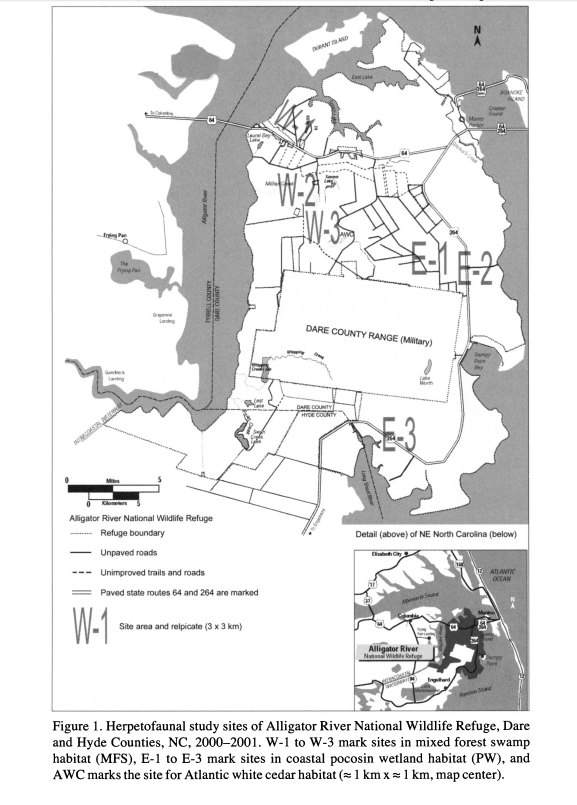
The Alligator River National Wildlife Refuge is 152,000 acres spreading across most of Dare and Hyde Counties, North Carolina. It spans roughly 8 miles (45 km) from north to south and 15 miles (24 km) from east to west in North Carolina’s Coastal Plain. It is bordered by the Alligator River, Long Shoal River, the Intracoastal Waterway, and the Albemarle, Croatan, and Pamlico Sounds. The refuge is renowned for its diverse ecosystems, encompassing pocosins (evergreen shrub and tree-dominated wetlands), swamps, freshwater and brackish water marshes, and forested areas. This variety of habitats supports a rich and varied array of flora and fauna. Alligator River is home to a wide range of wildlife species, including black bears, red wolves, river otters, white-tailed deer, alligators, and a plethora of bird species. Plant species include pitcher plants and sundews, low bush cranberries, redbay, Atlantic white cypress, pond pine, American sweetgum, red maple, and a wide variety of herbaceous and shrub species.
The original crash site of the UAP was at the north edge of the peninsula bordered by the Albemarle Sound.
[3.0.0] Incident Timeline
11:45 PM September 1st — Beginning of probable time window for initial crash landing of UAP.
3:00 AM September 2nd — End of probable time window for initial crash landing of UAP.
2:00 PM September 2nd — U.S. Navy personnel escorted NASA, Dept. of Interior, Fish and Wildlife Services, and Geological Survey researchers to the crash site, a party of 38 in total.
2:50 PM September 2nd — The initial crash site, several thousand feet wide, begins rapidly expanding upon physical examination by two Geological Survey researchers. A “shimmer”-like border is observed to materialize, surrounding the area. All communication with the party is lost.
3:21 PM September 2nd — 33 of the personnel in the party emerge from the crash site, the other 5 missing. Returning personnel suffer from acute memory loss, unable to explain or remember the events that took place over the 31 minute period.
9:30 PM September 2nd — First reports from residents across Dare county of a strange, colorful visual phenomenon in the night sky.
6:49 AM September 5th — First reports from residents across Dare and Hyde counties of unusual wildlife behavior, discolored water, and a pervasive, acrid odor that hung in the air.
6:35 AM September 7th — Mission X, the expedition into the growing affected area begins. All three subjects pass through the boundary to explore the site. All communication is immediately lost.
12:53 PM September 29th — Subjects X and Y return through the boundary. Subject Z does not emerge. The border ceases expansion and stagnates.
8:05 AM October 6th — Subjects begin exhibiting strange, at times antisocial, behaviors. Both are transported to Womack Army Medical Center for observation.
3:55 AM October 10th — Subject Y expires. Cause and manner of death unknown.
5:47 AM October 10th — Subject X disappears from custody at Womack Army Medical Center.
6:53 AM October 10th — The border begins rapidly expanding again.
[4.1.0] General Recommendations
[4.1.1] NASA, with full support from the U.S. Navy, U.S. Department of the Interior, the U.S. Geological Survey, and the U.S. Fish and Wildlife Service, has made the discretionary recommendation to continue disallowing access to Alligator River and its immediate surroundings through containment procedures, by any means necessary,including deadly force.
[4.1.2] To ensure the continuance of formal containment procedures and readiness to address the ongoing expansion of the boundary, NASA recommends the formation of a U.S. Commission on Extraterrestrial Threat Assessment and Response(ETAR) to supervise a comprehensive program of monitoring and containment.
[End of Document]
This document represents an executive overview of the September 2023 disaster which caused the closure of the Alligator River National Wildlife Refuge to the public and current containment procedures.